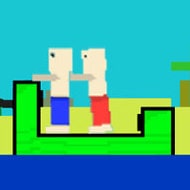
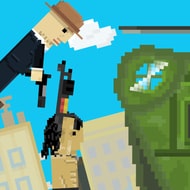
What actually happens when your rival grabs the sniper rifle two seconds before the finish line? In Getaway Shootout that single pickup can flip a race that looked won. The whole point is reaching the checkpoint first, but the route there is littered with pistols, shotguns, bombs, and melee weapons, and every one of them changes the next ten seconds. Newcomers tend to treat it like a straightforward foot race, then get flattened by a shotgun blast from a rival who understood the map first.
The Jump-Charge Mechanic Behind Every Race
Movement is not a run button. Racers hop by holding a direction key and releasing it, and the length of that hold decides how far the hop goes. Tap it and you get a stumbling half-step; hold it and you launch across a rooftop gap or straight into a hazard you didn’t see coming. This single mechanic is why the ragdoll bodies look clumsy on purpose — every hop has weight and follow-through, and mistiming one mid-air sends a racer tumbling instead of landing clean.
Because turning and jumping share the same small set of keys, close-quarters moments turn chaotic fast. Two racers scrambling over the same train-track section will often flail into each other, bounce off a ledge, and lose more time than if they’d just walked. Learning to read the charge — how long a hold produces how much distance on a given surface — is the actual skill ceiling here, more than reaction speed.
Once that timing clicks, the same rooftop gaps that flattened a first attempt start feeling routine, and the difference between a clean cross and a faceplant becomes obvious a half-second before it happens.
What Beginners Get Wrong Early On
The most common mistake is holding the jump key too long on flat ground, which wastes distance and leaves a racer airborne exactly when a rival lines up a shotgun shot. The second is ignoring weapon pickups entirely because the goal “is just to run” — but a bomb tossed at a doorway chokepoint can end a race outright, and skipping every pickup on the way to the checkpoint means never having an answer for someone who didn’t skip theirs.
New racers also under-use the shop between rounds. Coins earned from placing well unlock new characters, and while skins don’t change hitboxes, learning a new racer’s silhouette helps you read rivals faster once you’ve played as a few of them yourself.
How the Later Maps Raise the Difficulty
Early courses are mostly open ground with the occasional gap, forgiving enough that a mistimed jump just costs a second or two. By the time you reach the rooftop-heavy maps, narrow ledges sit directly above bottomless drops, and a single miscalculated charge undoes an entire lead. The train-track stages add moving hazards on top of the jump-timing problem, forcing racers to charge a hop while also tracking where a rival’s last pistol shot came from.
What changes isn’t really the geometry — it’s how unforgiving that same geometry becomes once weapon pickups are added into the mix. A gap that was trivial on an earlier map turns into a coin-flip when someone’s holding a shotgun at the far edge.
This is the part players argue about most: some find the physics endearingly janky, others find the same ragdoll flailing frustrating when it costs a race they felt they’d already won. Both reactions come from the same source — the game never fully lets you trust your own aim.
Weapon Priority on Cluttered Maps
- Pistols reward quick reflexes but run out of ammo fast, so save shots for a rival mid-jump rather than spraying early.
- Shotguns punish close range hard, making them the best answer to someone trying to shove past at a chokepoint.
- Bombs work best thrown ahead at a doorway or ledge a rival has to cross, rather than at someone already next to you.
Advanced Techniques Most Players Miss
Experienced racers chain jump charges — releasing one hop early enough to start charging the next before landing, which shaves fractions of a second off a run that add up over a full course. It looks reckless, but it’s deliberate: they’re accepting a slightly rougher landing in exchange for not losing momentum to a full stop.
Another overlooked trick is using a rival’s own weapon fire against them. Standing just behind cover while a rival wastes a pistol clip, then rushing the gap while they reload, works because most players don’t track ammo count under pressure. Casual players rarely plan around this because the pace of a short race doesn’t leave much room to think — it rewards the racers who’ve already internalized it.
- Practice jump-charge lengths on an empty map before worrying about weapons at all.
- Learn each map’s chokepoints so you know where rivals are likely to fight rather than run.
Time Trial as a Practice Tool
Time Trial strips away rivals and weapons entirely, leaving just the course and the clock. It’s the fastest way to learn a map’s jump distances without getting shotgunned mid-attempt, and competitive players use it constantly to shave seconds off a route before ever bringing that route into a real race.
Getaway Shootout Questions Players Ask
Why does my racer keep tumbling instead of jumping cleanly?
That’s the jump-charge system — hold time controls distance, and releasing too early or too late on uneven ground tips the ragdoll off balance. Practicing on flat sections of a map before attempting rooftop gaps fixes most of this.
Is there a way to avoid getting shot right before the finish?
Not entirely, but staying aware of ammo counts and cutting through cover near the last stretch reduces how often a rival gets a clean shotgun angle on you at the checkpoint.
Which weapon is best for a beginner to rely on?
The pistol is the most forgiving since it doesn’t require close range, making it easier to learn timing on before moving to shotguns or bombs that punish bad positioning harder.
None of that changes what actually decides a round of Getaway Shootout: whoever reads the jump-charge timing and the weapon pickups on a given map faster wins, and everyone else ends up watching a rival’s bomb go off at the exact doorway they were about to cross.